App store fees UK: what the CMA could change for you

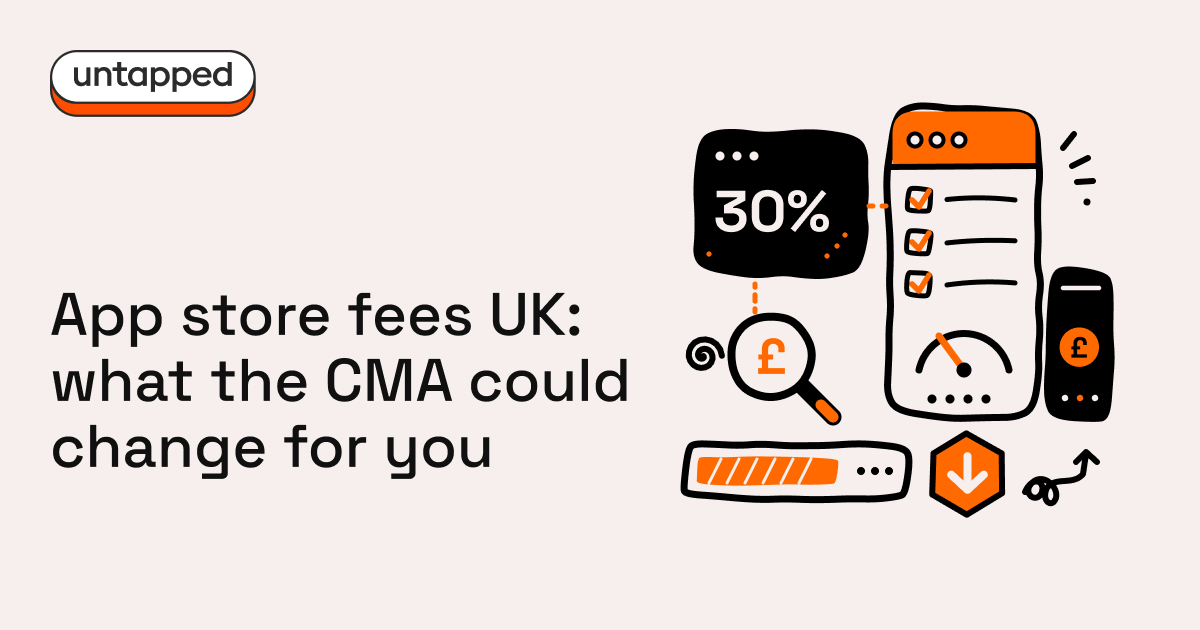
Most businesses with an app accept store commission as the price of doing business. The CMA, the UK's competition regulator, says Apple and Google charge up to 30% on some in-app purchases. For an app that sells subscriptions or content, that's often the biggest single cost between a customer's tap and your bank account.
Now the rules may change. The CMA has proposed requirements that would let developers point customers to other ways to pay, and it expects any fee for doing so to be lower than today's charges. If they go ahead, app store fees UK businesses pay could fall, and the way people check out in your app could look very different.
Nothing has changed yet, and Apple is fighting the proposal. This post covers what's on the table, where it stands and what it means for your margins. It also shows how to get your payment setup ready, so you can move quickly when a decision lands.
What the CMA is proposing on app store fees in the UK
The CMA wants to stop Apple and Google blocking developers from telling customers about other ways to pay. This is called steering. Under the proposals, any fee the two companies charge for steering must be fair and reasonable, and the CMA expects it to be lower than current app store charges.
What steering means in practice
Steering is when an app tells users they can buy somewhere else, usually on the developer's own website and often at a different price. In the UK, Apple bans it and Google restricts it. A business selling a subscription in its iOS app generally can't link to a cheaper web checkout.
The CMA's draft would remove those restrictions. It also covers indirect blocks, such as contract terms, technical design requirements and app review practices. That detail matters, because a rule that allows steering on paper but makes it awkward in practice won't help anyone.
Why the CMA can step in
In October 2025 the CMA gave Apple and Google strategic market status in mobile platforms. That lets it set conduct requirements for the two companies under the Digital Markets, Competition and Consumers Act 2024. Both firms had already offered commitments on app review and developer data, which took effect on 1 April 2026. Steering is the next step.
Fees would still exist, but they should be lower
The CMA isn't proposing free steering. Apple and Google could still charge, but the draft sets out principles for how those fees are worked out. They include keeping cost records and not double counting costs that are already recovered elsewhere. The CMA expects the savings to reach UK customers or go back into developers' businesses.
The CMA has also said it's holding wider measures in reserve, including directly constraining Apple's commission fees. Steering is the first move, and it might not be the last.
What Apple and Google charge UK developers today
To judge a lower fee, you need to know today's. These are the headline rates from Apple's and Google's own documentation, as of October 2026. Both set their thresholds in US dollars, so check your own developer agreement for the rate you pay.
Apple App Store
- Standard rate: 30% on paid apps and in-app purchases, the top rate the CMA cites.
- Small Business Program: 15% if your proceeds were up to $1 million last calendar year, and you have to enrol. Cross $1 million in the current year and the standard rate applies to later sales. Apple's programme page has the rules.
- Subscriptions: Apple's subscriptions page says you keep 70% in a subscriber's first year of paid service, a 30% commission, and 85% after that. Small Business Program members get 85% from day one.
Google Play
Google changed its UK fees on 30 June 2026. It now charges a service fee on every transaction, plus a separate billing fee if you use its own payment system.
- Service fee: 10% on your first $1 million of annual earnings and on all subscriptions. Above that, in-app purchases cost 20% for new installs and 25% for existing installs. It applies whatever the payment route, including external web links.
- Billing fee: an extra 5% if you use Google Play Billing. It doesn't apply to alternative billing or external web links.
- In practice: an in-app subscription through Google Play Billing costs 15%, which is 10% plus 5%. With an external web link, you pay the 10% service fee plus your own payment costs.
Google's Play Console Help page says details of its external web link programme are still to come. Read the conditions before you rely on that route.
These rates are the baseline. If the CMA's steering fees come in below them, that's your saving. If they don't, the case for switching gets thinner.
Where the proposal stands and what to watch
The consultation closed on 28 July 2026, and the CMA has said it will decide later this year whether to impose the requirements. As far as we can tell, no final decision has been published, so nothing is different for developers today.
Apple has pushed back. In its response it described the proposal as "highly intrusive" and argued that the consultation never explains why its current commission model needs to change. Apple says the commission pays for the tools, technologies and services the App Store gives developers. Google says it already allows steering and has updated its UK fees, although some restrictions still apply.
Here's the position at a glance:
- Apple: bans steering in the UK today and opposes the proposed rules.
- Google: restricts steering today, says it already allows it, and has changed its fees.
- The CMA: expects to decide later this year, with steering fees it expects to be lower than today's.
Three things are worth watching once the decision arrives:
- The final wording. Whether the rules cover indirect blocks, like app review practices, will decide how usable steering really is.
- The fee. "Lower than today" isn't a number. The level, and how it's calculated, will decide whether steering pays off for you.
- The start date. A decision isn't the same as a change on your customers' phones. Expect a gap between the two.
Both sides have a point
It's easy to cast this as developers against the platforms, but the argument has two sides. Apple has long said that its payment system and store rules help keep customers safe from fraud and malware, and that its commission funds the platform. Critics of steering add that sending people to other checkouts brings privacy and fraud risks of its own.
The counter argument is about choice and cost. When two companies set the terms, developers have little room to negotiate, and customers pay for that in higher prices. The CMA has to weigh the two. For you, the practical point is to expect conditions attached to steering rather than a clean switch.
Why app store fees in the UK matter beyond your own margins
The CMA estimates the UK app economy generates 1.5% of UK GDP and supports around 400,000 jobs. It also says around 90 to 100% of UK mobile devices run on Apple or Google platforms, which is why it describes the two as an effective duopoly.
For a business, that means there's no real alternative route to your customers. If you want to be on a phone, you're in one of two stores. That position is what gives the platforms the power to set fees and rules, and it's why regulators in the EU, US and Japan are looking at the same questions.
A word on the numbers. The 1.5% and 400,000 figures are estimates, and trade bodies trace them back to 2021 research. Treat them as a sense of scale rather than an exact count.
What changes for businesses that charge for subscriptions or content
If your app sells subscriptions or digital content, two things could change: how much of each payment you keep, and where your customers pay.
Your margins
Here's a simple illustration. Say you sell a £10 monthly subscription and pay a 30% commission, so £3 goes before you count any other cost. If a steering fee were 10 points lower, you'd keep an extra £1 on each payment. Across 20,000 subscribers, that's £20,000 a month.
That's an illustration, not a forecast. The final fee isn't known, and you'd take on costs the stores cover today, such as payment processing. The real saving is the fee difference minus those costs.
Your checkout flow
Moving customers out of your app to pay adds steps, and every extra step can lose you a sale. You'd also take on jobs the stores handle for you now, like VAT, refunds, failed payments and fraud checks.
So the true cost of steering is a mix of the fee, your processing costs, the extra support work and any customers who drop out along the way. Some businesses will come out well ahead. Others will find the saving is smaller than it looked.
Who stands to gain most
Steering won't suit every app equally. Businesses with higher priced subscriptions, content libraries or memberships have the most to gain, because commission takes a bigger bite out of each payment. So do businesses that already have a website, a login system and a way to take card payments.
Low priced, impulse purchases are different. If a customer pays £1.99 to unlock a feature, sending them to a web checkout adds friction that can cost more than the fee saves. For those apps, the store's one tap payment may stay the better route.
Many businesses will end up offering both and letting customers choose. That's another reason to build for flexibility rather than a full switch.
Plan around a range, not a number
Nobody knows the final fee, so don't build a business case around one figure. Model a few scenarios instead: the fee stays as it is, it drops a little, it drops a lot. Then check which ones still make steering worth doing for your customers.
How to get your payment setup ready for app store fee changes in the UK
The best preparation is a setup that lets you change where payment happens without rebuilding your app. At Untapped we build mobile apps and digital products, and we work with businesses in fintech and SaaS, including Utility Warehouse and Auto Service Plan. Our advice is to treat payments as something you'll change, not something you set once. Here's what that looks like in practice.
- Keep pricing and access in your own backend. Record what each customer has paid for and what they can use in your own system, not only in app store receipts. Then it doesn't matter where they paid.
- Choose a payment provider that works in and out of your app. You want one set of products, prices and customer records, whether someone pays through the store or makes off-platform payments on your website.
- Build a switch. Use a feature flag so you can turn a web checkout route on or off by market, platform or customer group, without releasing a new version of your app.
- Design the journey in both directions. Plan how a customer moves from your app to checkout and back. Use deep links, keep them signed in, and make sure access unlocks straight away.
- Sort the back office. Reporting, VAT, refunds and support will all need to work across more than one payment route. Fix that before customers use it.
- Know your baseline. Record conversion, churn and net revenue per customer by platform today. Without that, you can't tell whether a new checkout is working.
Mistakes to avoid
- Hard coding store specific product IDs and prices into your app, so every pricing change needs a new release.
- Splitting customer records between the stores and your own system, so you can't see who's paying for what.
- Waiting for the final decision before you start. Payment changes take time to design, test and release.
One warning. Don't change your checkout now in a way that breaks Apple's or Google's current terms. Build the ability to switch, then switch when the rules allow it.
If you're planning a new app or a rebuild, this is the cheapest moment to add that flexibility. It's far easier to design it in than to unpick payment logic later. See how we approach mobile app development.
What to do next
The CMA's proposals could lower app store fees in the UK, but nothing is decided, and the final fee matters as much as the principle. Three points are worth taking away:
- Steering would let you point customers to other ways to pay, with fees the CMA expects to be lower than today's.
- The saving depends on the final fee, your processing costs and how many customers you keep at a new checkout.
- A payment setup that can switch routes quickly puts you in a good position whichever way the decision goes.
Start by looking at where your payment logic lives today. If you'd like a second opinion on your app's checkout, [link to: contact Untapped].
FAQs
What is app store steering?
Steering is when an app tells users they can buy somewhere other than the app store, usually on the developer's own website. In the UK, Apple bans it and Google restricts it. The CMA has proposed removing those restrictions.
How much do Apple and Google charge UK developers?
Apple charges 30% as standard, 15% under its Small Business Program, and 30% then 15% on subscriptions. Google charges a service fee of 10% to 25%, plus 5% if you use Google Play Billing. See the section on today's fees above for the detail.
Can I take payments outside the app store in the UK now?
Apple bans steering in the UK today, and Google restricts it. Google says it already allows steering and has updated its fees, but restrictions still apply. Read the current terms before you change anything.
When will the CMA decide?
The consultation closed on 28 July 2026, and the CMA has said it will decide later this year. As far as we can tell, no final decision has been published yet, so check the CMA's website for the latest.
Will steering fees be lower than app store fees?
The CMA expects them to be lower than current app store charges, and says any fee should be fair and reasonable. The actual level won't be known until the final decision, so plan around a range.
Does this affect Google Play as well as the App Store?
Yes. The CMA has proposed steering requirements for both Apple and Google. Google has already changed some of its UK terms, while Apple has opposed the proposal.




















Any thoughts?
Leave a comment